Saturday, November 5, 2011

Thessalonica

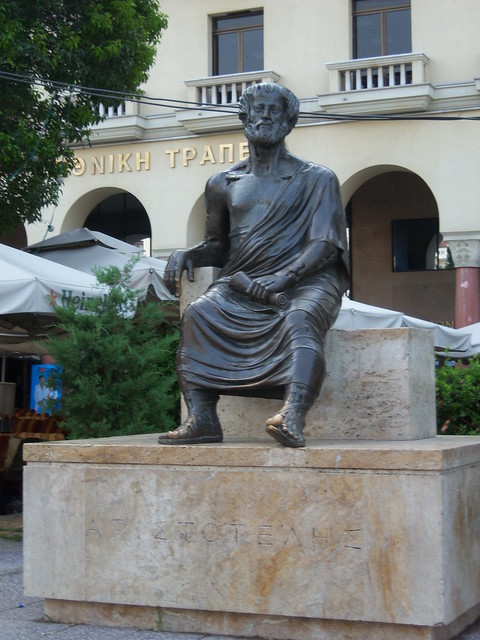
Aristotle in Thessalonica
Acts 17:1-10
Paul and Silas traveled through the cities of Amphipolis and Apollonia and came to the city of Thessalonica, where there was a synagogue. As usual, Paul went into the synagogue. On three consecutive days of worship, he had discussions about Scripture with the synagogue members. He explained and showed them that the Messiah had to suffer, die, and come back to life, and that Jesus, the person he talked about, was this Messiah.  Some of the Jews were persuaded to join Paul and Silas, especially a large group of Greeks who had converted to Judaism and the wives of many prominent men.
Then the Jews became jealous. They took some low-class characters who hung around the public square, formed a mob, and started a riot in the city. They attacked Jason’s home and searched it for Paul and Silas in order to bring them out to the crowd. When they didn’t find Paul and Silas, they dragged Jason and some other believers in front of the city officials. They shouted, “Those men who have made trouble all over the world are now here in Thessalonica, and Jason has welcomed them as his guests. All of them oppose the emperor’s decrees by saying that there is another king, whose name is Jesus.”  The crowd and the officials were upset when they heard this. But after they had made Jason and the others post bond, they let them go. Immediately when night came, the believers sent Paul and Silas to the city of Berea.

1)    What do you notice about this story?


Two books of the New Testament are Paul’s letters to these believers, called 1st and 2nd Thessalonians.  Paul often wrote and spoke of how soon the Lord was returning, and the Thessalonians thought he meant before anybody died. So when people died … they were worried. Paul reassures them of their faith, and then comforts them about the last day.

1 Thessalonians 1:6-8
In spite of a lot of suffering, you welcomed God’s word with the kind of joy that the Holy Spirit gives. This way, you became a model for all the believers in the province of Macedonia and Greece. From you the Lord’s word has spread out not only through the province of Macedonia and Greece but also to people everywhere who have heard about your faith in God. We don’t need to say a thing about it.

2)    Why would they be doubting their faith? Would this be reassuring to people doubting their faith?


1 Thessalonians 4:13-18
Brothers and sisters, we don’t want you to be ignorant about those who have died. We don’t want you to grieve like other people who have no hope. We believe that Jesus died and came back to life. We also believe that, through Jesus, God will bring back those who have died. They will come back with Jesus.  We are telling you what the Lord taught. We who are still alive when the Lord comes will not go into his kingdom ahead of those who have already died. The Lord will come from heaven with a command, with the voice of the archangel, and with the trumpet call of God. First, the dead who believed in Christ will come back to life. Then, together with them, we who are still alive will be taken in the clouds to meet the Lord in the air. In this way we will always be with the Lord.  So then, comfort each other with these words!

3)    Whoa! That’s a pretty direct description of the end. What do you think?


1 Thessalonians 5:1…6
Brothers and sisters, you don’t need anyone to write to you about times and dates. You know very well that the day of the Lord will come like a thief in the night. … That day won’t take you by surprise as a thief would. You belong to the day and the light not to the night and the dark. Therefore, we must not fall asleep like other people, but we must stay awake and be sober.

4)    This fits what Jesus says about the day of the Lord, also.  Some people think about this as talking about how no one knows the length of their own life, and some people think it’s about the end of history. Either way, why does it matter that it’s a surprise?


1 Thessalonians 5:14-15
We encourage you, brothers and sisters, to instruct those who are not living right, cheer up those who are discouraged, help the weak, and be patient with everyone. Make sure that no one ever pays back one wrong with another wrong. Instead, always try to do what is good for each other and everyone else.

5)    That’s pretty direct advice. Have you done any of those things? Can you think of any opportunities you’ve had to do them?


2 Thessalonians 2:1-3, 8
Brothers and sisters, we have this request to make of you about our Lord Jesus Christ’s coming and our gathering to meet him. Don’t get upset right away or alarmed when someone claims that we said through some spirit, conversation, or letter that the day of the Lord has already come. Don’t let anyone deceive you about this in any way. That day cannot come unless a revolt takes place first, and the man of sin, the man of destruction, is revealed. … Then the man of sin will be revealed and the Lord Jesus will destroy him by what he says. When the Lord Jesus comes, his appearance will put an end to this man.

6)    Double whoa! That’s a description of what some people refer to as the Antichrist.  Does it seem possible that some person could deceive that many people?  Does Paul think we need to worry about it?


2 Thessalonians 3:8-13
We lived a disciplined life among you. We didn’t eat anyone’s food without paying for it. Instead, we worked hard and struggled night and day in order not to be a burden to any of you. It’s not as though we didn’t have a right to receive support. Rather, we wanted to set an example for you to follow. While we were with you, we gave you the order: “Whoever doesn’t want to work shouldn’t be allowed to eat.”

We hear that some of you are not living disciplined lives. You’re not working, so you go around interfering in other people’s lives. We order and encourage such people by the Lord Jesus Christ to pay attention to their own work so they can support themselves. Brothers and sisters, we can’t allow ourselves to get tired of doing what is right.
7)    What does working hard have to do with your spiritual life?


EDIT:
The morning of the study this question occurred to me, and it was fruitful with the students.

8) What are the things that might make Christians discouraged in their faith nowadays? What might Paul write to them?

The what-Paul-might-write was our jot down reflection of the week.


Then we tried inventing a card game to go with the gospel story of the wise and foolish bridesmaids - but that's clearly another post for another day.

Image credits: Classical languages, Share the Word @ Flickr

Sunday, October 30, 2011

Dem Bones

Youth are doing this study which is an adaptation of a study from our family for Halloween a couple years ago.

Skull and Bones
Prophet for 20 plus years in the 6th century BC, Ezekiel came after Isaiah (8th-740 BC) and Jeremiah (7th-625 BC).  His name means “God strengthens.”  He prophesied to the people of Judah living in Babylon.  They were confused and disheartened.  Since they worshipped in the Temple, they didn’t know if they could reach God anymore.  Ezekiel preached that they were in exile because of disobedience, and could return to Judah once they repented and returned to God.  Because of the way he wrote and historical records, they are some very accurate estimates of when he made the prophesies recorded. Ezekiel refers to the Torah quite often (e.g., Ezek. 27; 28:13; 31:8; 36:11, 34; 47:13, etc.) is familiar with the writings of Hosea (Ezek. 37:22), Isaiah (Ezek. 8:12; 29:6), and especially Jeremiah, (Jeremiah 24:7, 9; 48:37).”

dimitrij @ Flickr
Read Ezekiel 37:1-14

1)    Is that a vision or did it happen?  Why do you think so?


2)    Why is the creation of the bodies and the instilling of spirit in two separate stages?  What other details do you wonder about here?


3)    What is the message here for the Jews?  Why is this message important to them?


 Read John 5: 16-30

4)    What do we learn about Jesus’ relationship with his Father in this passage?  What does it have to do with the ‘work on the Sabbath issue’?


5)    What does Jesus reveal about resurrection here?  Why the connection with hearing him?


6)    What does his relationship with the Father have to do with resurrection?


Read 1 Corinthians 15:12-26

7)    Why would people have been telling the Corinthians there was no resurrection?  Is there a parallel in our time?


8)    What is Paul’s argument that there is a resurrection?


9)    What does this passage have to say about when and how the resurrection of the body takes place?


10)    Does the resurrection of the body matter to you?  How does it affect your faith or your living of it?


Bonus Scripture
11)    What connections do you see between these other passages and our texts for the study?

(Ps 104: 29-32)   When you hide your face, they are terrified; when you take away their breath, they die and return to the dust. When you send your Spirit, they are created, and you renew the face of the earth. May the glory of the LORD endure forever; may the LORD rejoice in his works- he who looks at the earth, and it trembles, who touches the mountains, and they smoke.

(2 Kings 13: 21)  Once while some Israelites were burying a man, suddenly they saw a band of raiders; so they threw the man’s body into Elisha’s tomb. When the body touched Elisha’s bones, the man came to life and stood up on his feet.


zoomar @ Flickr
(Isaiah 26:19)  But your dead will live; their bodies will rise. You who dwell in the dust, wake up and shout for joy. Your dew is like the dew of the morning; the earth will give birth to her dead.

(1 Thes 4:16-17)  For the Lord himself will come down from heaven, with a loud command, with the voice of the archangel and with the trumpet call of God, and the dead in Christ will rise first.  After that, we who are still alive and are left will be caught up together with them in the clouds to meet the Lord in the air. And so we will be with the Lord forever.

(Rev 20:4-6)  I saw thrones on which were seated those who had been given authority to judge. And I saw the souls of those who had been beheaded because of their testimony for Jesus and because of the word of God. They had not worshiped the beast or his image and had not received his mark on their foreheads or their hands. They came to life and reigned with Christ a thousand years.  (The rest of the dead did not come to life until the thousand years were ended.) This is the first resurrection.  Blessed and holy are those who have part in the first resurrection. The second death has no power over them, but they will be priests of God and of Christ and will reign with him for a thousand years.

Double Bonus
I love Nadia Bolz-Weber's sermon on this. Please go read it in its entirety. Here's a snippet to get you motivated:

Sarcastic Lutheran – Sermon Excerpt; Texts:  Ezekiel 47:1-14

Just when this Lenten desert seems too much to bear, today we walk through a graveyard.  And what awaits us but a little Easter.  A foretaste of the feast to come  surrounded by corpses and a boneyard.  Here amidst the dusty remnant of a wasted humanity we see God’s spirit breath life into a valley of dry bones and raise the dead.  Ezekiel had prophesied to Israel for some time, but still the temple lay in ruin like bones bleached white in the unmerciful brightness of humiliation, conquest and exile. At the beginning of the book Ezekiel is told by God to eat the scroll and after eating it he was THEN told to go speak God’s word to them because God’s word does what it says.  We too get to delve so deeply into this word that we practically are EATING it.  God’s word made flesh.  God’s word proclaimed.  God’s word in holy text.  The word of God that raises the dead.  Maybe it looks like tasteless paper, simple wafers and wine, a boring preachers but , as Ezekiel tells us in chapter 2,  the Word is as sweet as honey.

God did not insist that Ezekiel agree with God’s word or that he even understand God’s word.  He was simply told to eat the word, then proclaim the word.  DO not pass go do not collect.  Just eat it and preach it.  And when he did, death was made to become valley dancing life.

Saturday, October 15, 2011

It's a Trap

So the leaders of Israel are mad and worried. They get it – this Jesus is serious trouble. Time to get rid of him. They think, “good thing he’s a dumb hick from Galilee and we are soooo clever.”

Matthew 22: 15-22 A Question About Taxes—Mark 12:13–17; Luke 20:20–26
Then the Pharisees went away and planned to trap Jesus into saying the wrong thing. They sent their disciples to him along with Herod’s followers. They said to him, “Teacher, we know that you tell the truth and that you teach the truth about the way of God. You don’t favor individuals because of who they are. So tell us what you think. Is it right to pay taxes to the emperor or not?” 

STOP! What’s the trap here?


What would you do?


 Jesus recognized their evil plan, so he asked, “Why do you test me, you hypocrites? Show me a coin used to pay taxes.” They brought him a coin. He said to them, “Whose face and name is this?” They replied, “The emperor’s.” Then he said to them, “Very well, give the emperor what belongs to the emperor, and give God what belongs to God.” They were surprised to hear this. Then they left him alone and went away. 

GO! How does Jesus get out of it?


Is he just getting out or making his own point?


What does belong to God?


There’s another power group in Israel – they’ve been losing ground to the Pharisees, but they see their chance. Saducees, enter stage left.

Matthew 22:23-32 The Dead Come Back to Life—Mark 12:18–27; Luke 20:27–40
On that day some Sadducees, who say that people will never come back to life, came to Jesus. They asked him, “Teacher, Moses said, ‘If a man dies childless, his brother should marry his widow and have children for his brother.’ There were seven brothers among us. The first married and died. Since he had no children, he left his widow to his brother. The second brother also died, as well as the third, and the rest of the seven brothers. At last the woman died. Now, when the dead come back to life, whose wife will she be? All seven brothers had been married to her.” 

STOP! What’s the trap here?


What would you do?


Jesus answered, “You’re mistaken because you don’t know the Scriptures or God’s power. When people come back to life, they don’t marry. Rather, they are like the angels in heaven. Haven’t you read what God told you about the dead coming back to life? He said, ‘I am the God of Abraham, Isaac, and Jacob.’ He’s not the God of the dead but of the living.” 

GO! How does Jesus get out of it?


Is he just getting out or making his own point?


What does he mean the God of the living?


What traps do Christians face today?
While Jesus at least was arguing with people who thought they believed in God, while today we could face traps by people completely opposed to the idea of God.

  • I’ve seen those Christians on TV and they are ignorant/stupid/judgmental/hypocrites… 

  • If God is infallible and the bible is the Word of God, how do you explain evolution/Noah/demons & angels… 
 
  • How does God go from wiping out whole nations in the Old Testament to being all lovey dovey in the New Testament? 
 
  • How can a good God allow famine/war/disease/natural disasters… 


Photo credit: Justin Good @ Flickr

Saturday, October 8, 2011

Sunday

a lesson from Matthew 23 using Nooma 04


Matthew 23:1-12
Then Jesus said to the crowds and to his disciples, “The scribes and the Pharisees teach with Moses’ authority. So be careful to do everything they tell you. But don’t follow their example, because they don’t practice what they preach. They make loads that are hard to carry and lay them on the shoulders of the people. However, they are not willing to lift a finger to move them. They do everything to attract people’s attention. They make their headbands large and the tassels on their shawls long. They love the place of honor at dinners and the front seats in synagogues. They love to be greeted in the marketplaces and to have people call them Rabbi. But don’t make others call you Rabbi, because you have only one teacher, and you are all followers. And don’t call anyone on earth your father, because you have only one Father, and he is in heaven. Don’t make others call you a leader, because you have only one leader, the Messiah. The person who is greatest among you will be your servant. Whoever honors himself will be humbled, and whoever humbles himself will be honored.” 

1) What do you think is Jesus’ big point here?


2) What do you suppose the Pharisees and scribes thought about it?


We’re going to watch Nooma 04: Sunday. (Trailer below.) It’s based on that passage above and Mark 7:1-22. Try to keep track of what you notice. If there’s a place you want to stop and talk, or rewind and rewatch, just say so.

3) What questions do you have?


4) What’s the big idea? How does it connect to what we read in Phillipians 3:7-9?
These things that I once considered valuable, I now consider worthless for Christ. It’s far more than that! I consider everything else worthless because I’m much better off knowing Christ Jesus my Lord. It’s because of him that I think of everything as worthless. I threw it all away in order to gain Christ and to have a relationship with him.

5) Jot down one thing you want to remember from this. Here's the trailer for Nooma 04. I'm sure you can find the whole video online, but I also urge you to support the ministry. They're doing downloads of individual Noomas for only $1.99 each now, or watch online for $1.00. 
 

Rob Bell makes reference to the Shema Israel here, and I agree that it goes well with what Jesus is saying. It's even how Jesus answers the scribes who ask him what the greatest commandment is. This presentation of the Shema is from Judaism 101, where you can see and hear the Hebrew, also:

Sh'ma Yis'ra'eil Adonai Eloheinu Adonai echad.
Hear, Israel, the Lord is our God, the Lord is One.

Barukh sheim k'vod malkhuto l'olam va'ed.
Blessed be the Name of His glorious kingdom for ever and ever.

V'ahav'ta eit Adonai Elohekha b'khol l'vav'kha uv'khol naf'sh'kha uv'khol m'odekha.
 And you shall love the Lord your God with all your heart and with all your soul and with all your might.

V'hayu had'varim ha'eileh asher anokhi m'tzav'kha hayom al l'vavekha.
And these words that I command you today shall be in your heart.

V'shinan'tam l'vanekha v'dibar'ta bam
And you shall teach them diligently to your children, and you shall speak of them

b'shiv't'kha b'veitekha uv'lekh't'kha vaderekh uv'shakh'b'kha uv'kumekha
when you sit at home, and when you walk along the way, and when you lie down and when you rise up.

Uk'shar'tam l'ot al yadekha v'hayu l'totafot bein einekha.
And you shall bind them as a sign on your hand, and they shall be for frontlets between your eyes.

Ukh'tav'tam al m'zuzot beitekha uvish'arekha.
And you shall write them on the doorposts of your house and on your gates.

The Shema almost always brings this song to mind:
 

Photo credit: Marion Doss @ Flickr. My Aunt Gert (Gertrude Golden) taught in a place like this.

Saturday, October 1, 2011

Dear Philippians

Dear Philippians: Don't Worry, Be Joyful. Love, Paul.

Adapted from Steve Brown’s Through the Eyes of Grace – the Prison Epistles.
Philippi by wallygrom @ Flickr

Introduction
Philippi was the leading city of Macedonia, situated on the Egnatian Way between Rome and Asia. Philippi took its name from Philip II of Macedonia who captured the cityand was the father of Alexander the Great. It was the most important city of the province, but not the capital. It became a full Roman city—a rare and great privilege. A financial center with natural attractions, too.

Acts 16 tells how Philippi was the first church established in Europe. Paul was led to Macedonia because of a vision and shortly thereafter met 3 people who founded the church: Lydia, an Asian professional woman, a girl possessed of a spirit who had been making a lot of money for her owners until Paul healed her, and Paul’s jailer who received Christ and whose household was baptized. Paul visited this church three times.

Paul’s letter to the Philippians was written around A.D. 62 from the city of Rome where Paul was in prison. But one of the major themes of Philippians is joy. Paul was joyful, not because of circumstances, but because of Jesus. When the church heard he was in jail, they sent a man to help, and Paul sent him back home with this letter.

Phil 1:15-18 
Some people tell the message about Christ because of their jealousy and envy. Others tell the message about him because of their good will. Those who tell the message about Christ out of love know that God has put me here to defend the Good News. But the others are insincere. They tell the message about Christ out of selfish ambition in order to stir up trouble for me while I’m in prison. But what does it matter? Nothing matters except that, in one way or another, people are told the message about Christ, whether with honest or dishonest motives, and I’m happy about that. 

1) Why would someone tell about Jesus for not good reasons? Why doesn’t that bother Paul? What’s most important to Paul?


Phil 1:21-23
Christ means everything to me in this life, and when I die I’ll have even more. If I continue to live in this life, my work will produce more results. I don’t know which I would prefer. I find it hard to choose between the two. I would like to leave this life and be with Christ. That’s by far the better choice. 

2) Is it possible Paul really didn’t care whether he lived or died? How would you explain that to someone?


Phil 2:14-18
Do everything without complaining or arguing. Then you will be blameless and innocent. You will be God’s children without any faults among people who are crooked and corrupt. You will shine like stars among them in the world as you hold firmly to the word of life. Then I can brag on the day of Christ that my effort was not wasted and that my work produced results. My life is being poured out as a part of the sacrifice and service I offer to God for your faith. Yet, I am filled with joy, and I share that joy with all of you. For this same reason you also should be filled with joy and share that joy with me. 

3) What do you like to complain about most? How does complaining keep you away from joy?


In chapter 3, Paul warns the Philippians to beware those who impose extra rules on them. (Like circumcision.) He explains how he was a better rule keeper than anyone. But…
Phil 3:6-16 
When it comes to being enthusiastic, I was a persecutor of the church. When it comes to winning God’s approval by keeping Jewish laws, I was perfect. These things that I once considered valuable, I now consider worthless for Christ. It’s far more than that! I consider everything else worthless because I’m much better off knowing Christ Jesus my Lord. It’s because of him that I think of everything as worthless. I threw it all away in order to gain Christ and to have a relationship with him. This means that I didn’t receive God’s approval by obeying his laws. The opposite is true! I have God’s approval through faith in Christ. This is the approval that comes from God and is based on faith that knows Christ. Faith knows the power that his coming back to life gives and what it means to share his suffering.
In this way I’m becoming like him in his death, with the confidence that I’ll come back to life from the dead. It’s not that I’ve already reached the goal or have already completed the course. But I run to win that which Jesus Christ has already won for me. Brothers and sisters, I can’t consider myself a winner yet. This is what I do: I don’t look back, I lengthen my stride, and I run straight toward the goal to win the prize that God’s heavenly call offers in Christ Jesus.
Whoever has a mature faith should think this way. And if you think differently, God will show you how to think. However, we should be guided by what we have learned so far. 

4) Does Paul think we have to try to be good to get right with God?


5) Does Paul think we should try to be good to please God?


6) Key sentence: “But I run to win that which Jesus Christ has already won for me.” How can you put that in your own words?


7) What does the end mean there?


Phil 4:4-9 
Always be joyful in the Lord! I’ll say it again: Be joyful! Let everyone know how considerate you are. The Lord is near. Never worry about anything. But in every situation let God know what you need in prayers and requests while giving thanks. Then God’s peace, which goes beyond anything we can imagine, will guard your thoughts and emotions through Christ Jesus. 
Finally, brothers and sisters, keep your thoughts on whatever is right or deserves praise: things that are true, honorable, fair, pure, acceptable, or commendable. Practice what you’ve learned and received from me, what you heard and saw me do. Then the God who gives this peace will be with you. 

8) What is worthy of praise in your life? For what should we praise God?


 This image by Alice Popkorn on Flickr came with the quote:
"Joy is what happens 
when we allow ourselves to recognize how good things really are."
- Marianne Williamson

Saturday, September 24, 2011

Do What You Do

by anyjazz65 @ Flickr
Do What You Do

There was a family with three kids. Their mother asked them to clean their rooms, because they were having company tomorrow. The first kid said ‘OK’ and went and cleaned her room. The second kid said ‘That’s not fair!’ and stormed off. But when he cooled down, he cleaned his room. The third kid said ‘no problem, mom,’ and went back to her room and listened to mp3s.

1) Who did what the mother wanted?


2) What does this story have to do with church?

Matthew 21:23-32 Jesus’ Authority Challenged (See also Mark 11:27–33; Luke 20:1–8)
Then Jesus went into the temple courtyard and began to teach. The chief priests and the leaders of the people came to him. They asked, “What gives you the right to do these things? Who told you that you could do this?” Jesus answered them, “I, too, have a question for you. If you answer it for me, I’ll tell you why I have the right to do these things. Did John’s right to baptize come from heaven or from humans?” They discussed this among themselves. They said, “If we say, ‘from heaven,’ he will ask us, ‘Then why didn’t you believe him?’ But if we say, ‘from humans,’ we’re afraid of what the crowd might do. All those people think of John as a prophet.” So they answered Jesus, “We don’t know.”

Jesus told them, “Then I won’t tell you why I have the right to do these things.

A Story About Two Sons
“What do you think about this? A man had two sons. He went to the first and said, ‘Son, go to work in the vineyard today.’ His son replied, ‘I don’t want to!’ But later he changed his mind and went. The father went to the other son and told him the same thing. He replied, ‘I will, sir,’ but he didn’t go. “Which of the two sons did what the father wanted?” “The first,” they answered.
Jesus said to them, “I can guarantee this truth: Tax collectors and prostitutes are going into the kingdom of God ahead of you. John came to you and showed you the way that God wants you to live, but you didn’t believe him. The tax collectors and prostitutes believed him. But even after you had seen that, you didn’t change your minds and believe him. 

3) What does the two sons story have to do with the leaders’ question: “what gives you the right to do this stuff?”


4) Do you have authority to act?


Philippians 2:6-13 Have the Same Attitude as Christ
Although he was in the form of God and equal with God,
he did not take advantage of this equality. 
Instead, he emptied himself by taking on the form of a servant,
by becoming like other humans, by having a human appearance. 
He humbled himself by becoming obedient to the point of death,
death on a cross. 
This is why God has given him an exceptional honor
– the name honored above all other names –
so that at the name of Jesus everyone in heaven, on earth, and in the world below
will kneel and confess that Jesus Christ is Lord to the glory of God the Father. 

My dear friends, you have always obeyed, not only when I was with you but even more now that I’m absent. In the same way continue to work out your salvation with fear and trembling. It is God who produces in you the desires and actions that please him. 

5) How does this connect to the gospel for today?

(The last Sunday of the month we leave more time for fellowship and games, so this is meant to be pretty quick.)

Friday, September 9, 2011

As we forgive

soot+chalk at Flickr
As We Forgive
The heart of our relationship with Jesus is accepting the forgiveness he offers. But in the Gospels he spoke much more about us forgiving others. Why? What does it mean? Is it a requirement for grace?

0) What do you think about when we pray in the Our Father “Forgive us our trespasses/debts as we forgive those who trespass against us”?


Matthew 18:15-35
Dealing With Believers When They Do Wrong (15-20) “If a believer does something wrong, go, confront him when the two of you are alone. If he listens to you, you have won back that believer. But if he does not listen, take one or two others with you so that every accusation may be verified by two or three witnesses. If he ignores these witnesses, tell it to the community of believers. If he also ignores the community, deal with him as you would a heathen or a tax collector. I can guarantee this truth: Whatever you imprison, God will imprison. And whatever you set free, God will set free. “I can guarantee again that if two of you agree on anything here on earth, my Father in heaven will accept it. Where two or three have come together in my name, I am there among them.” 

1) So what are the different stages? Why break it up into those stages?


2) What does it mean when Jesus says to deal with them as you would a tax collector? How did Jesus treat tax collectors?


3) What on earth could the guaranteed truth mean here? We have the power to imprison? All we have to do is agree?


4) What does it mean to come together in Jesus’ name? 


Personally Forgiving Others (21-35) Then Peter came to Jesus and asked him, “Lord, how often do I have to forgive a believer who wrongs me? Seven times?”
Jesus answered him, “I tell you, not just seven times, but seventy times seven. That is why the kingdom of heaven is like a king who wanted to settle accounts with his servants. When he began to do this, a servant who owed him millions of dollars was brought to him. Because he could not pay off the debt, the master ordered him, his wife, his children, and all that he had to be sold to pay off the account. Then the servant fell at his master’s feet and said, ‘Be patient with me, and I will repay everything!’ The master felt sorry for his servant, freed him, and canceled his debt. But when that servant went away, he found a servant who owed him hundreds of dollars. He grabbed the servant he found and began to choke him. ‘Pay what you owe!’ he said. Then that other servant fell at his feet and begged him, ‘Be patient with me, and I will repay you.’ But he refused. Instead, he turned away and had that servant put into prison until he would repay what he owed. The other servants who worked with him saw what had happened and felt very sad. They told their master the whole story. Then his master sent for him and said to him, ‘You evil servant! I canceled your entire debt, because you begged me.  Shouldn’t you have treated the other servant as mercifully as I treated you?’ His master was so angry that he handed him over to the torturers until he would repay everything that he owed. That is what my Father in heaven will do to you if each of you does not sincerely forgive other believers.” 


5) What questions do you have about this parable? Some questions that maybe you did or did not ask.


6) Is a gift given if it is not received? Meaning, if I give you something, and you refuse to open it, did I give you a gift? Have you ever gotten a gift that you did not receive?


7) Why does the servant treat his debtor so harshly? What would that be like for us or in today’s culture?


8) Why does it make the king so angry when he hears about the servant’s actions?


9) Does it mean that the king did not really forgive the servant if he takes it back? Or is the servant being punished for the new problem and not the old debt?


10) Here’s an interpretation: the servant does not really understand or accept what the king did. He thinks it’s easy for the king, or inconsequential, and so it makes no difference in his life. Real understanding of what the king did for him would make it impossible to treat the lower servant so. The king is angry, confronted with proof that his generosity was not accepted for what it was.

Does this make sense with the parable?


Yukata Tsutako, 3/20/2001

September 11th.
 11) Have you forgiven Al Qaeda for the attack of 9/11/01? What does it mean for us to forgive them?


12) What would the political reaction be if a leader called on America to forgive Al Qaeda?


13) What would it mean for a jihadist group to accept our forgiveness?


I usually don't share my answers to these studies, but I think I have to for #13.  I had 2 new or renewed insights studying this scripture. One is that what Jesus told us to do is always for our own good. He told us to forgive others not to assign a burden, but so that we will understand what he has done for us. If we don't understand it, we can't really accept it. The harder it is for us to forgive someone, the more deeply we'll understand just what we did. The second has to do with #13. That, paradoxically, God's forgiveness serves his justice. To us it feels like forgiving someone is letting them off the hook. But if they accept the forgiveness, truly, then it is the best way for them to understand their wrong.  Persecuting them for the wrong helps them justify and ignore it.