Showing posts with label John. Show all posts

Saturday, September 14, 2013

A Hard Teaching

0)    What is the hardest teaching of Jesus for you? Does anything come to mind?


Previously in the Gospel of John: (5:1-15) Jesus heals on the Sabbath, getting himself and the former lame man in trouble with Jewish authorities. (5:16-47) Jesus continues to heal on the sabbath, continues to claim God as his father, and exacerbates conflict with the authorities when he criticizes them deeply and publicly. (6:1-15) Jesus feeds 5000+ with 2 loaves and 5 fishes. (6:16-21) Jesus walks on water to join the disciples in a boat.

1)    Can you imagine hearing through the grapevine that these things are going on? What would you think? Would you seek this person out?


Read John 6:22-27
2)    When do we seek Jesus for the food that spoils? What does that look like these days?


3)    Work is always a dangerous word because of baggage and connotations. How is Jesus using it here? What is work for eternal food?


Isaiah 55:1-4 “Listen! Whoever is thirsty, come to the water! Whoever has no money can come, buy, and eat! Come, buy wine and milk. You don’t have to pay; it’s free!  Why do you spend money on what cannot nourish you and your wages on what does not satisfy you? Listen carefully to me: Eat what is good, and enjoy the best foods. Open your ears, and come to me! Listen so that you may live! I will make an everlasting promise to you - the blessings I promised to David. I made him a witness to people, a leader and a commander for people.
4)    How does this connect to what Jesus is saying?


Read John 6:28-32
5)    “What does God want us to do?” Boy is that a good question the people asked Jesus! His response depends on translation.
NIV: ‘ 29 Jesus answered, “The work of God is this: to believe in the one he has sent.” ’
GW: ‘29 Jesus replied to them, “God wants to do something for you so that you believe in the one whom he has sent.” ’
Seems like a significant difference.  How do you interpret was Jesus is saying?


6)    Are the people being naïve or actively trying to manipulate Jesus to get what they want? (Or both?) Are there any ways we try to manipulate God?


Read John 6:34-40
7)    Obviously Christians have been hungry and thirsty to the point of death, and Jesus was clear he was the bread. So what do you think he means with the never hungry nor thirsty?


8)    This sounds like predestination in the first half of v. 37. But it sounds like free will in the second half of v. 37.  What is Jesus saying?


9)    Not to get too deep in the end times stuff, but what does Jesus mean by “bring to life on the last day”?


Read John 6:41-51
Link: Isaiah 54:13 All your children will be taught by the Lord, and your children will have unlimited peace.
10)    Isn’t this a pretty reasonable criticism? Why might Jesus have reacted so strongly?


11)    What does Jesus having seen the Father have to do with eternal life here?


Bread! Bread is seriously important to the Jews. From it’s first mention in scripture on. (Gen 3:19 “By the sweat of your brow, you will produce bread to eat until you return to the ground, because you were taken from it. You are dust, and you will return to dust.”) The word bread can mean food in general, the very means of sustenance. To eat bread requires special hand washing and a special blessing. And by bringing up manna Jesus already has them thinking about Deuteronomy 8:3: “So he made you suffer from hunger and then fed you with manna, which neither you nor your ancestors had seen before. He did this to teach you that a person cannot live on bread alone but on every word that the Lord speaks.”

12)    How can we understand how much Jesus saying this would freak them out?


Read John 6:52-60
Now his blood, too! Another freak out. The main requirement of meat to be kosher is complete bloodlessness, because of this command:
Genesis 4:1, 3-4 God blessed Noah and his sons and said to them… 3  “Everything that lives and moves will be your food. I gave you green plants as food; I now give you everything else. But you are not to eat meat with blood in it. (Blood is life.)”
And furthermore, the Greek language used here has switched from the usual word for eat to a word more like devour.

13)    What can we, as disciples, do when what Jesus is saying is hard to accept?


14)    How do you make sense of this hard teaching?


Read John 6:61-70.
15)    Verse 63 reminds me of C.S.Lewis’ line: you do not have a soul. You are a soul; you have a body.  What does it mean that life is spiritual? How do you keep your focus on that?


16)    What do you take away from this whole exchange? Why did Jesus give this message at this point in time? What does it say to us?

Saturday, May 14, 2011

Baaaaa


Notes from Sitting at the Feet of Rabbi Jesus, by Spangler and Tverberg.  This is the Lakeshore Lutheran Fellowship's men's group study, which is a little longer.  There's a link to the youth study at the end.
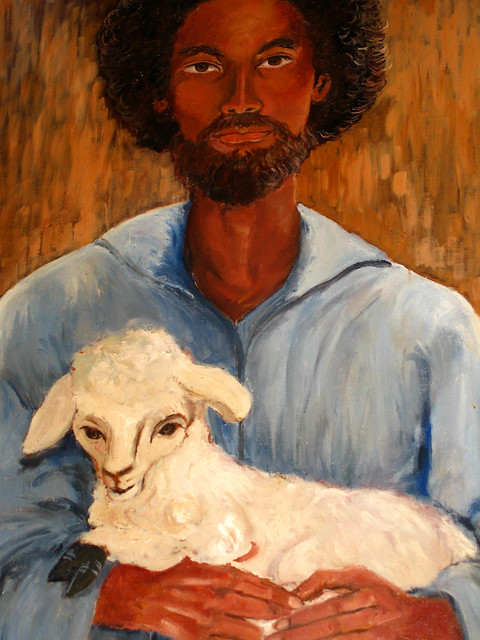
 Painting from Grace Memorial Presbyterian in Pittsburgh.


Read John 10:1-21 Jesus, the Good Shepherd (Link goes to biblegateway.com's God's Word translation.)
1) Why were the Jews divided? “He’s possessed by a demon” is a pretty strong response to sheep talk.


It was not the first time Jesus mentioned shepherds. Read Luke 15:1-7 (also in Matthew 18:12-13)
All the tax collectors and sinners came to listen to Jesus. But the Pharisees and the scribes complained, “This man welcomes sinners and eats with them.”
Jesus spoke to them using this illustration: “Suppose a man has 100 sheep and loses one of them. Doesn’t he leave the 99 sheep grazing in the pasture and look for the lost sheep until he finds it? When he finds it, he’s happy. He puts that sheep on his shoulders and goes home. Then he calls his friends and neighbors together and says to them, ‘Let’s celebrate! I’ve found my lost sheep!’ I can guarantee that there will be more happiness in heaven over one person who turns to God and changes the way he thinks and acts than over 99 people who already have turned to God and have his approval.”

2) What do you notice about this parable?


Of course, if we’re talking shepherds…

Psalm 23 A psalm by David.
The Lord is my shepherd. I am never in need.
He makes me lie down in green pastures.
He leads me beside peaceful waters.
He renews my soul.
He guides me along the paths of righteousness for the sake of his name.
Even though I walk through the dark valley of death, because you are with me, I fear no harm.
Your rod and your staff give me courage.
You prepare a banquet for me while my enemies watch.
You anoint my head with oil.
My cup overflows.

Certainly, goodness and mercy will stay close to me all the days of my life, and I will remain in the Lord’s house for days without end.

3) How do you respond to this poem? Why?


4) This was famous among the Jews of Jesus’ day, just as it is now. If what Jesus said reminded people of this psalm, what would it mean to them?


In a nation of shepherds, as they still were, which even began with Abraham, the shepherd image might have meant more.

Isaiah 44:28 [The Lord] says about Cyrus, “He is my shepherd. He will do everything I want him to do. He says about Jerusalem, “It will be rebuilt. He says about the temple, “Your foundation will be laid.”

Psalm 78:70-72 He chose his servant David. He took him from the sheep pens. He brought him from tending the ewes that had lambs so that David could be the shepherd of the people of Jacob, of Israel, the people who belonged to the LORD. With unselfish devotion David became their shepherd. With skill he guided them.

5) With what do these passages connect the idea of a shepherd? What would that have meant to Jesus’ audience?


One of the most sheep heavy sections of scripture is Ezekiel 34. Read that now.
6) What connections are there between this chapter and what Jesus says in John 10?


7) What does this mean for Jesus’ listeners if they connected his words to this chapter? What is Jesus telling them?


8) If they accept what Jesus is saying here, because they believe through other signs, as they mention, what will that mean for them?


Jesus mentions sheep elsewhere, too. Read Matthew 25:31-33.
[Jesus speaking] “When the Son of Man comes in his glory and all his angels are with him, he will sit on his glorious throne. The people of every nation will be gathered in front of him. He will separate them as a shepherd separates the sheep from the goats. He will put the sheep on his right but the goats on his left.”

9) How does this connect with the passage from Ezekiel?


10) What is Jesus telling the people about himself here?


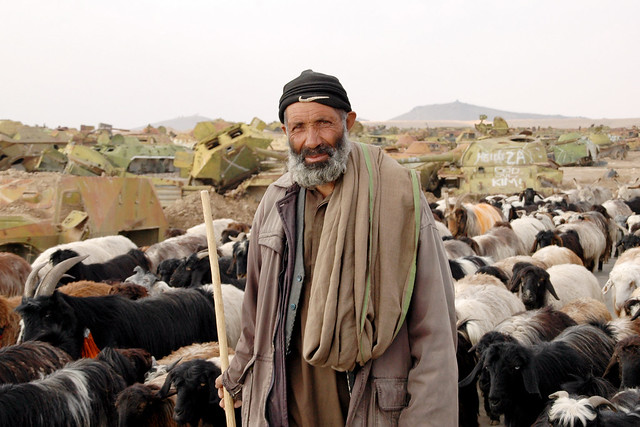
Shepherd outside Kabul, Afghanistan, 2008
11) Back to John 10… what is it saying to us today? Does your experience match what Jesus says or contradict it?
  • We’ll respond to Jesus’ voice.
  • Jesus will call us by name.
  • Jesus will lead us.
  • We will not follow a stranger – we’ll even run away from them.
  • We will have life and everything we need.


12) If we accept what Jesus is saying here, what will that mean for us?


Photo Credits: annspangler.com, KitAy and AfghanistanMatters @ Flickr,

Resources:
The terrific book linked up at the top.  Seriously worth your time.
The Hardest Question - site for bible teachers that follows the liturgical calendar.  They concentrate on posing the hardest questions that scripture raises for them, with different pastors contributing each week.

The youth version of this study is at Scribd.  A bit shorter, with all the scripture on the page.

This made for a great discussion with the men's group.  One of the things it brought up for us was how important it is to share the good news, and that one of the ways is by being a good follower.  That brings to mind this mini TED talk, on what it takes to start a movement.


Thursday, April 14, 2011

Open

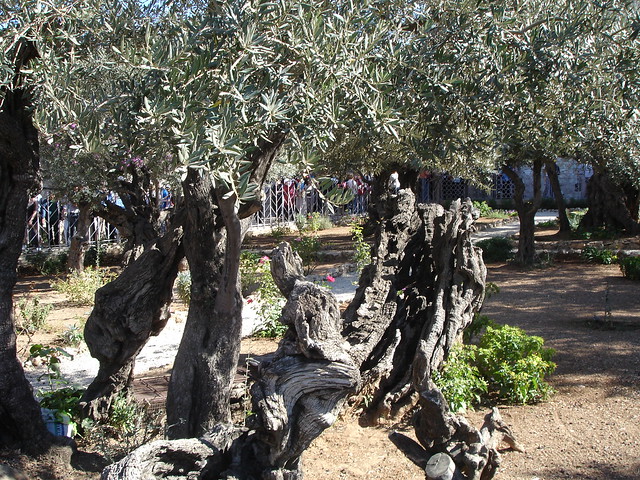
Gethsemane today.
Start with prayer:
  • Something you know about God – Praise Him!
  • Take a minute to talk to God about something you wish you hadn’t done. (Not out loud.)
  • Thank God for something He’s done.
  • Is there anything you want God to do?

Matthew 26:36-42
Then Jesus went with the disciples to a place called Gethsemane. He said to them, “Stay here while I go over there and pray.” He took Peter and Zebedee’s two sons with him. He was beginning to feel deep anguish. Then he said to them, “My anguish is so great that I feel as if I’m dying. Wait here, and stay awake with me.” After walking a little farther, he quickly bowed with his face to the ground and prayed, “Father, if it’s possible, let this cup of suffering be taken away from me. But let your will be done rather than mine.”

When he went back to the disciples, he found them asleep. He said to Peter, “Couldn’t you stay awake with me for one hour? 41Stay awake, and pray that you won’t be tempted. You want to do what’s right, but you’re weak.” Then he went away a second time and prayed, “Father, if this cup cannot be taken away unless I drink it, let your will be done.”

Psalm 13 (a psalm by David.)
How long, O Lord? Will you forget me forever?
How long will you hide your face from me?
How long must I make decisions alone with sorrow in my heart day after day?
How long will my enemy triumph over me?

Look at me! Answer me, O Lord my God!
Light up my eyes, or else I will die and my enemy will say, “I have overpowered him.”
My opponents will rejoice because I have been shaken.

But I trust your mercy.
My heart finds joy in your salvation.
I will sing to the Lord because he has been good to me.

Watch the Nooma called Open. (019)


(This is a trailer. Of course you can find the whole thing on you tube, but you might consider supporting the ministry by buying it.)

1. What did you notice?


2. Why is it important to be honest – even brutally honest – with God about how we feel? How was David or Jesus honest?


3. Why should we pray? What will we get out of it?


Before Jesus went to the garden, he prayed for his followers – including us!

John 17:9-26
“I pray for them. I’m not praying for the world but for those you gave me, because they are yours. Everything I have is yours, and everything you have is mine. I have been given glory by the people you have given me. I won’t be in the world much longer, but they are in the world, and I’m coming back to you. Holy Father, keep them safe by the power of your name, the name that you gave me, so that their unity may be like ours. While I was with them, I kept them safe by the power of your name, the name that you gave me. I watched over them, and none of them, except one person, became lost. So Scripture came true.

“But now, Father, I’m coming back to you. I say these things while I’m still in the world so that they will have the same joy that I have. I have given them your message. But the world has hated them because they don’t belong to the world any more than I belong to the world. I’m not asking you to take them out of the world but to protect them from the evil one. They don’t belong to the world any more than I belong to the world.

Use the truth to make them holy. Your words are truth. I have sent them into the world the same way you sent me into the world. I’m dedicating myself to this holy work I’m doing for them so that they, too, will use the truth to be holy.

“I’m not praying only for them. I’m also praying for those who will believe in me through their message. I pray that all of these people continue to have unity in the way that you, Father, are in me and I am in you. I pray that they may be united with us so that the world will believe that you have sent me. I have given them the glory that you gave me. I did this so that they are united in the same way we are. I am in them, and you are in me. So they are completely united. In this way the world knows that you have sent me and that you have loved them in the same way you have loved me.

“Father, I want those you have given to me to be with me, to be where I am. I want them to see my glory, which you gave me because you loved me before the world was made. Righteous Father, the world didn’t know you. Yet, I knew you, and these disciples have known that you sent me. I have made your name known to them, and I will make it known so that the love you have for me will be in them and I will be in them.”

4. How can you know that Jesus was praying this for you as well as praying it for his disciples then?


5. What are three of the several things Jesus prayed for us? Pick one: why would he want that for us?


6. What part of this prayer matters the most to you? Why does it matter to know that Jesus wants that for you


7. Write down one thing that you got out of today’s lesson.


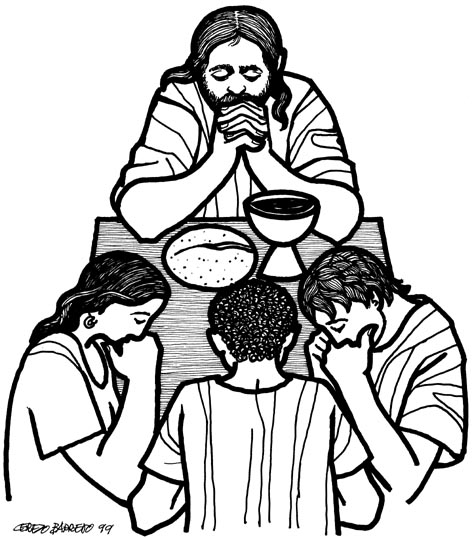
Photo credits: from Flickr, lyng883; from servicioskoinonia.org via markdaniels.blogspot.com

Wednesday, March 2, 2011

Rhythm


Rhythm
photo: Jacob Whittaker @ Flickr

When you think about God, do you have a picture in your head?


If you do, what do you picture?


Where did that picture come from?


Here is a preview of the video.  (You can find the whole thing online, but I encourage you to support the ministry if you like their materials.)


Scripture from the video:
Exodus 3:14 
And God said unto Moses, I AM THAT I AM: and he said, Thus shalt thou say unto the children of Israel, I AM hath sent me unto you.

Deuteronomy 4:15-18
You saw no form of any kind the day the LORD spoke to you at Horeb out of the fire. Therefore watch yourselves very carefully, so that you do not become corrupt and make for yourselves an idol, an image of any shape, whether formed like a man or a woman, or like any animal on earth or any bird that flies in the air, or like any creature that moves along the ground or any fish in the waters below.

John 4:24  God is sheer being itself – Spirit. Those who worship him must do it out of their very being, their spirits, their true selves, in adoration.

John 10:10  I came so that everyone would have life, and have it in its fullest.

Discussion Questions
Why do you think people, including some writers of the Bible use human physical references like “hands,” “feet,” “eyes,” and “he” to describe God, when other Scriptures state that God is a spirit and has no form?


What do these characteristics of God mean: truth, love, grace, mercy, justice, compassion? 


Does he have these characteristics or is He these?  Like ‘He is truthful’ or ‘He is truth’?


Is what we believe or what we do more important to Jesus?  How do you know?


What does Jesus mean by “life in the fullest”?


Do you believe that if you live the way Jesus taught us to live, being in tune with the song, that you will have life in its fullest?


Jot down one thing you got from this video and discussion:

Sunday, August 8, 2010

Worship

Next week's men's study is going to be about worship.  I was already thinking about it because of its prevalence in Moses' story.  "Let my people go," we're familiar with but leave it unfinished, "so we can go worship the Lord of Israel."  Then they worship, but, of course, don't limit themselves to the Lord.

The catalyst this week was Kurt Vonnegut, who is famous for being a humanist.  But he's not an agressive atheist like Hitchens or Dawkins; he just wants people to do good for the sake of doing good.  Which I see as pretty close to God's call.  In this speech at Albion College, "How to get a job like mine," he said the following about creativity:  go home tonight and write a 6 line poem.  Make it rhyme because you're not playing if there's no rules.  Make it as good as you can.  And then tear it up into tiny pieces.  Tell no one.  Distribute it among widely scattered trash receptacles.  Then you will have done a creative act.  No money!

That really struck a chord in me, because I was right with him until he said tear it up.  Then my sensibilities were offended... but the time, or I could share it with someone, tight? or can't I just twitter it first?  If I can't do that with a dumb poem (as I'm not much of a poet), how can I even think my worship isn't selfless.

So the questions I'm mulling are:
  • What is worship?
  • Why do we worship?
  • How do we worship?

And the scriptures I'm starting with:
Jn 4:21-24 Jesus declared, "Believe me, woman, a time is coming when you will worship the Father neither on this mountain nor in Jerusalem.  You Samaritans worship what you do not know; we worship what we do know, for salvation is from the Jews.  Yet a time is coming and has now come when the true worshipers will worship the Father in spirit and truth, for they are the kind of worshipers the Father seeks.  God is spirit, and his worshipers must worship in spirit and in truth."

Is 29:13  (Quoted by Jesus in Mt 15:7-9) The Lord says: "These people come near to me with their mouth and honor me with their lips, but their hearts are far from me. Their worship of me is made up only of rules taught by men.

Romans 12:1-2
Therefore, I urge you, brothers, in view of God's mercy, to offer your bodies as living sacrifices, holy and pleasing to God—this is your spiritual act of worship.  Do not conform any longer to the pattern of this world, but be transformed by the renewing of your mind. Then you will be able to test and approve what God's will is—his good, pleasing and perfect will.

Is 12:1-6
In that day you will say: "I will praise you, O LORD. Although you were angry with me, your anger has turned away and you have comforted me.  Surely God is my salvation; I will trust and not be afraid. The LORD, the LORD, is my strength and my song; he has become my salvation."  With joy you will draw water from the wells of salvation.  In that day you will say: "Give thanks to the LORD, call on his name; make known among the nations what he has done, and proclaim that his name is exalted.  Sing to the LORD, for he has done glorious things; let this be known to all the world.  Shout aloud and sing for joy, people of Zion, for great is the Holy One of Israel among you."

If anyone reads this (crickets...), I'd love to hear what you think in the comments.  How do you worship?  Why do you worship?  Or what do you think it means to worship in spirit?

To close, how about one of our favorite family worship tunes, from Robin Mark: