Showing posts with label John the Baptist. Show all posts

Saturday, December 10, 2011

The In Betweeners


The In Betweeners… that’s us!
Advent is a great time for considering what it means to be waiting for Christ.

BCers:  Isaiah
Isaiah 40:1-11
Comfort, O comfort my people, says your God. Speak tenderly to Jerusalem, and cry to her that she has served her term, that her penalty is paid, that she has received from the LORD’s hand double for all her sins. A voice cries out: “In the wilderness prepare the way of the LORD, make straight in the desert a highway for our God. Every valley shall be lifted up, and every mountain and hill be made low; the uneven ground shall become level, and the rough places a plain. Then the glory of the LORD shall be revealed, and all people shall see it together, for the mouth of the LORD has spoken.”
A voice says, “Cry out!” And I said, “What shall I cry?” All people are grass, their constancy is like the flower of the field. The grass withers, the flower fades, when the breath of the LORD blows upon it; surely the people are grass. The grass withers, the flower fades; but the word of our God will stand forever. Get you up to a high mountain, O Zion, herald of good tidings; lift up your voice with strength, O Jerusalem, herald of good tidings, lift it up, do not fear; say to the cities of Judah, “Here is your God!” See, the Lord GOD comes with might, and his arm rules for him; his reward is with him, and his recompense before him. He will feed his flock like a shepherd; he will gather the lambs in his arms, and carry them in his bosom, and gently lead the mother sheep. 

1) This is the beginning of the 2nd part of Isaiah, where Israel is in exile. How is this comforting to them?


2) Are we in need of comfort now? In what way are people still in exile? How might this comfort them today?

John the Baptizer: Read Mark 1:1-8
The beginning of the good news of Jesus Christ, the Son of God. As it is written in the prophet Isaiah,
"See, I am sending my messenger ahead of you,
who will prepare your way;
the voice of one crying out in the wilderness:
`Prepare the way of the Lord, make his paths straight,'"
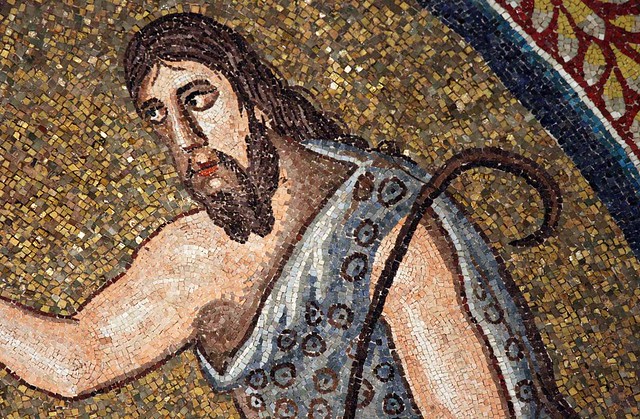
John the baptizer appeared in the wilderness, proclaiming a baptism of repentance for the forgiveness of sins. And people from the whole Judean countryside and all the people of Jerusalem were going out to him, and were baptized by him in the river Jordan, confessing their sins. Now John was clothed with camel's hair, with a leather belt around his waist, and he ate locusts and wild honey. He proclaimed, "The one who is more powerful than I is coming after me; I am not worthy to stoop down and untie the thong of his sandals. I have baptized you with water; but he will baptize you with the Holy Spirit." 

3) Crazy corner preachers are so rarely successful. But John was. Why do you think?


The following is probably too long a quote from Nadia Bolz-Weber's sermon on this. Please go read the whole thing.
“Repentance – which in Greek means something closer to “thinking differently afterwards” than it means change your cheating ways. Of course repentance CAN look like a prostitute becoming a librarian but repentance can also look like a whore saying ok I’m a sex worker and I have no idea how to get out but I can come here and receive bread and wine and maybe if only for a moment I can hold onto the love of God without being deemed worthy of it by anyone but God. Repentance is a con artist being a real person for the first time ever without knowing who that person is anymore but knowing he sees it in the eyes of those serving him communion naming him a Child of God. Repentance is realizing there is more life to be had in being proved wrong than in continuing to think you’re right. Repentance is the adult child of an fundamentalist saying I give up on waiting for my mom to love me for who I am so I’m gonna rely on God to help me love her for who she is because I know she’s not going to be around forever. Repentance is unexpected beauty after a failed suicide attempt. Repentance is a couple weeks ago when the clerk at the Adult bookstore on Colfax teared up and said “your church brought me thanksgiving lunch?” Repentance is what happened to me when at the age of 28 my first community college teacher told me I was smart and despite all my past experience of myself I believed her. See, repentance is what happens to us when the Good News, the truth of who we are and who God is, enters our lives and scatters the darkness of competing ideas.”

4) Nadia Bolz-Weber (The Sarcastic Lutheran) had that amazing take on repentance. What do you think? Can that fit with your image of repentance? What area of your life needs repentance?


Fellow In Betweener: Peter
2 Peter 3:8-15a
Do not ignore this one fact, beloved, that with the Lord one day is like a thousand years, and a thousand years are like one day. The Lord is not slow about his promise, as some think of slowness, but is patient with you, not wanting any to perish, but all to come to repentance. But the day of the Lord will come like a thief, and then the heavens will pass away with a loud noise, and the elements will be dissolved with fire, and the earth and everything that is done on it will be disclosed. Since all these things are to be dissolved in this way, what sort of persons ought you to be in leading lives of holiness and godliness, waiting for and hastening the coming of the day of God, because of which the heavens will be set ablaze and dissolved, and the elements will melt with fire? But, in accordance with his promise, we wait for new heavens and a new earth, where righteousness is at home. Therefore, beloved, while you are waiting for these things, strive to be found by him at peace, without spot or blemish; and regard the patience of our Lord as salvation.

5) How would you sum up Peter’s take on waiting? Is it still relevant for us today or was it more for those expecting Jesus any day?


6) What does “regard the patience of our Lord as salvation” mean?

The End of Waiting: Read Mark 13:24-37
 Jesus said to his disciples, "In those days, after that suffering, the sun will be darkened, and the moon will not give its light, and the stars will be falling from heaven, and the powers in the heavens will be shaken. Then they will see `the Son of Man coming in clouds' with great power and glory. Then he will send out the angels, and gather his elect from the four winds, from the ends of the earth to the ends of heaven.
"From the fig tree learn its lesson: as soon as its branch becomes tender and puts forth its leaves, you know that summer is near. So also, when you see these things taking place, you know that he is near, at the very gates. Truly I tell you, this generation will not pass away until all these things have taken place. Heaven and earth will pass away, but my words will not pass away.
"But about that day or hour no one knows, neither the angels in heaven, nor the Son, but only the Father. Beware, keep alert; for you do not know when the time will come. It is like a man going on a journey, when he leaves home and puts his slaves in charge, each with his work, and commands the doorkeeper to be on the watch. Therefore, keep awake-- for you do not know when the master of the house will come, in the evening, or at midnight, or at cockcrow, or at dawn, or else he may find you asleep when he comes suddenly. And what I say to you I say to all: Keep awake." 

7) For the Jews in exile, awaiting the messiah was clearly positive. It would mean the fulfillment of astounding promises. Is that what Jesus’ return is for us, or is it something different?


8) Keep awake. Be wise. Trim our wicks… how do we do that? How is living with a resurrected Savior than different from living with a resurrected Savior who’s coming back.


Bonus poetry: a friend was marveling over the wonder of the incarnation, and I stumbled on this bit of poetry that captured some of the wonder for me:
We who must die demand a miracle.
How could the Eternal do a temporal act,
The Infinite become a finite fact?
Nothing can save us that is possible:
We who must die demand a miracle. 
(short excerpt from For the Time Being – WH Auden. Link to a longer excerpt)

9) How can we prepare for Christmas like it is good news, surprising and noteworthy, instead of a story that we’ve heard a large number of times?


Double bonus: Auden's For the Time Being is a 50 page poem,  subtitled "a Christmas Oratorio."  The chorus is also amazing...
He is the Way.
Follow Him through the Land of Unlikeness;
You will see rare beasts, and have unique adventures.

He is the Truth.
Seek Him in the Kingdom of Anxiety;
You will come to a great city that has expected your return for years.

He is the Life.
Love Him in the World of the Flesh;
And at your marriage all its occasions shall dance for joy.
Recalls Narnia and The Lord of the Rings, doesn't it?

Friday, December 10, 2010

John the Baptist

Sorry - forgot to post this last week!  We did this as a middle school study to just try to dig into the story of John the Baptist.  Or John the Baptizer as our pastor prefers.  I'm afraid I shocked the students though with my dramatic reading of Zechariah's canticle.  I encourage you to read it like Zechariah might have said it.  A guy who had the most amazing thing in the world happen to him, is not able to talk about it for a year, and then you recover your speech at the same moment as you have your longed-for, impossible, miraculous son... wow!

Make Way

Advent (literally “the coming”) is the traditional church season of preparation for Christmas, celebrated the four Sundays before Christmas.  Each year the readings feature John the Baptist.  Makes sense, as he was all about preparation.  John is one of the most famous people from the Bible, as he is mentioned throughout the gospels and has as dramatic a story as is possible.  We will follow his story in this study, and consider what his story tells us about preparation.

Isaiah has just finished giving some unheeded bad news to Hezekiah, and then writes this passage that is often called “Comfort for God’s People.”  Read Isaiah 40:1-11
"Comfort, oh comfort my people," says your God. 
"Speak softly and tenderly to Jerusalem, but also make it very clear that she has served her sentence, that her sin is taken care of-forgiven!  She's been punished enough and more than enough, and now it's over and done with." 
Thunder in the desert! "Prepare for God's arrival!  Make the road straight and smooth, a highway fit for our God.  Fill in the valleys, level off the hills, Smooth out the ruts, clear out the rocks.  Then God's bright glory will shine and everyone will see it. Yes. Just as God has said." 
A voice says, "Shout!" I said, "What shall I shout?" 
"These people are nothing but grass, their love fragile as wildflowers.  The grass withers, the wildflowers fade, if God so much as puffs on them. Aren't these people just so much grass?  True, the grass withers and the wildflowers fade, but our God's Word stands firm and forever." 
Climb a high mountain, Zion. You're the preacher of good news.  Raise your voice. Make it good and loud, Jerusalem. You're the preacher of good news. Speak loud and clear. Don't be timid!  Tell the cities of Judah, "Look! Your God!"  Look at him! God, the Master, comes in power, ready to go into action.  He is going to pay back his enemies and reward those who have loved him. 
Like a shepherd, he will care for his flock, gathering the lambs in his arms, Hugging them as he carries them, leading the nursing ewes to good pasture.
1.    What is the comfort in this passage?


Read Luke 1:5-25
In the time of Herod king of Judea there was a priest named Zechariah, who belonged to the priestly division of Abijah; his wife Elizabeth was also a descendant of Aaron.  Both of them were righteous in the sight of God, observing all the Lord's commands and decrees blamelessly.  But they were childless because Elizabeth was not able to conceive, and they were both very old. 
Once when Zechariah's division was on duty and he was serving as priest before God,  he was chosen by lot, according to the custom of the priesthood, to go into the temple of the Lord and burn incense.  And when the time for the burning of incense came, all the assembled worshipers were praying outside. 
Then an angel of the Lord appeared to him, standing at the right side of the altar of incense.  When Zechariah saw him, he was startled and was gripped with fear.  But the angel said to him: “Do not be afraid, Zechariah; your prayer has been heard. Your wife Elizabeth will bear you a son, and you are to call him John.  He will be a joy and delight to you, and many will rejoice because of his birth,  for he will be great in the sight of the Lord. He is never to take wine or other fermented drink, and he will be filled with the Holy Spirit even before he is born.  He will bring back many of the people of Israel to the Lord their God.  And he will go on before the Lord, in the spirit and power of Elijah, to turn the hearts of the parents to their children and the disobedient to the wisdom of the righteous-to make ready a people prepared for the Lord.” 
Zechariah asked the angel, “How can I be sure of this? I am an old man and my wife is well along in years.”  The angel said to him, “I am Gabriel. I stand in the presence of God, and I have been sent to speak to you and to tell you this good news.  And now you will be silent and not able to speak until the day this happens, because you did not believe my words, which will come true at their appointed time.” 
Meanwhile, the people were waiting for Zechariah and wondering why he stayed so long in the temple.  When he came out, he could not speak to them. They realized he had seen a vision in the temple, for he kept making signs to them but remained unable to speak.  When his time of service was completed, he returned home.  After this his wife Elizabeth became pregnant and for five months remained in seclusion.  “The Lord has done this for me,” she said. “In these days he has shown his favor and taken away my disgrace among the people.”
2.    What connections to other parts of scripture do you notice here?


This passage recalls the Old Testament calling of a Nazirite: a consecrated person who abstains from alcohol and hair cutting.  Read Luke 1:57-80
When it was time for Elizabeth to have her baby, she gave birth to a son.  Her neighbors and relatives heard that the Lord had shown her great mercy, and they shared her joy.  On the eighth day they came to circumcise the child, and they were going to name him after his father Zechariah, but his mother spoke up and said, “No! He is to be called John.”  They said to her, “There is no one among your relatives who has that name.”
Then they made signs to his father, to find out what he would like to name the child.  He asked for a writing tablet, and to everyone’s astonishment he wrote, “His name is John.”  Immediately his mouth was opened and his tongue set free, and he began to speak, praising God.  All the neighbors were filled with awe, and throughout the hill country of Judea people were talking about all these things.  Everyone who heard this wondered about it, asking, “What then is this child going to be?” For the Lord’s hand was with him. 
Zechariah’s Song
His father Zechariah was filled with the Holy Spirit and prophesied:
“Praise be to the Lord, the God of Israel, because he has come to his people and redeemed them. He has raised up a horn of salvation for us in the house of his servant David (as he said through his holy prophets of long ago), salvation from our enemies and from the hand of all who hate us − to show mercy to our ancestors and to remember his holy covenant, the oath he swore to our father Abraham: to rescue us from the hand of our enemies, and to enable us to serve him without fear in holiness and righteousness before him all our days. 
And you, my child, will be called a prophet of the Most High; for you will go on before the Lord to prepare the way for him, to give his people the knowledge of salvation  through the forgiveness of their sins, because of the tender mercy of our God, by which the rising sun will come to us from heaven to shine on those living in darkness and in the shadow of death, to guide our feet into the path of peace.” 
And the child grew and became strong in spirit[d]; and he lived in the wilderness until he appeared publicly to Israel.
3.    What do think this prophesy might have meant for John’s life as he grew up?


Read Luke 3:15-22
The people were waiting expectantly and were all wondering in their hearts if John might possibly be the Messiah.  John answered them all, “I baptize you with water. But one who is more powerful than I will come, the straps of whose sandals I am not worthy to untie. He will baptize you with the Holy Spirit and fire.  His winnowing fork is in his hand to clear his threshing floor and to gather the wheat into his barn, but he will burn up the chaff with unquenchable fire.”  And with many other words John exhorted the people and proclaimed the good news to them. 
But when John rebuked Herod the tetrarch because of his marriage to Herodias, his brother’s wife, and all the other evil things he had done,  Herod added this to them all: He locked John up in prison. 
When all the people were being baptized, Jesus was baptized too. And as he was praying, heaven was opened and the Holy Spirit descended on him in bodily form like a dove. And a voice came from heaven: “You are my Son, whom I love; with you I am well pleased.”

4.    How did John fulfill his father’s and Isaiah’s prophesy?


Read Matthew 14:1-12
At that time Herod the tetrarch heard the reports about Jesus,  and he said to his attendants, “This is John the Baptist; he has risen from the dead! That is why miraculous powers are at work in him.” 
Now Herod had arrested John and bound him and put him in prison because of Herodias, his brother Philip’s wife, for John had been saying to him: “It is not lawful for you to have her.” Herod wanted to kill John, but he was afraid of the people, because they considered John a prophet. 
On Herod’s birthday the daughter of Herodias danced for the guests and pleased Herod so much that he promised with an oath to give her whatever she asked. Prompted by her mother, she said, “Give me here on a platter the head of John the Baptist.”  The king was distressed, but because of his oaths and his dinner guests, he ordered that her request be granted and had John beheaded in the prison.  His head was brought in on a platter and given to the girl, who carried it to her mother.  John’s disciples came and took his body and buried it. Then they went and told Jesus.

5.    What can we learn from the end of John’s life?  What do you think it meant to Jesus?


John’s message was to prepare the way for the Lord. 
6.    What do we learn from the scripture so far about how to prepare for the Lord’s coming?